

Inheritance is a fundamental concept of Object-Oriented Programming (OOP) that allows a class to acquire accessible fields, properties, and methods from another class. It helps developers reuse existing code and establish relationships between classes.
- A derived class (child class) inherits accessible members from a base class (parent class).
- A derived class can add new functionality or override inherited virtual or abstract methods.
- C# uses the colon (:) symbol to specify inheritance.
Example : Program to demonstrates how multiple classes inherit from a common base class and provide their own implementations of an inherited method.
using System;

// Base class
class Animal{
    public virtual void Sound(){
        Console.WriteLine("Animal makes a sound");
    }
}

// Derived class
class Dog : Animal{
    public override void Sound(){
        Console.WriteLine("Dog barks");
    }
}

// Derived class
class Cat : Animal{
    public override void Sound(){
        Console.WriteLine("Cat meows");
    }
}

// Derived class
class Cow : Animal{
    public override void Sound(){
        Console.WriteLine("Cow moos");
    }
}

class Geeks{
    static void Main(){
        Animal a;

        a = new Dog();
        a.Sound();

        a = new Cat();
        a.Sound();

        a = new Cow();
        a.Sound();
    }
}
Output
Dog barks
Cat meows
Cow moos
Explanation:
- Animal is the base class containing the virtual method Sound().
- Dog, Cat, and Cow inherit from Animal and override Sound() with their own implementations.
- The Animal reference stores objects of different derived classes.
- When Sound() is called, C# executes the overridden method based on the actual object type, demonstrating runtime polymorphism.
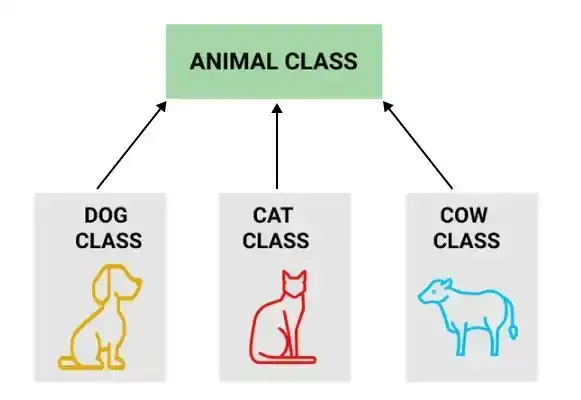
Syntax: A class inherits from another class using the colon (:) symbol.
class Parent
{
// Fields, properties, and methods
}
class Child : Parent
{
// Additional members
}
Here, Parent is the base class, while Child is the derived class.
Key Terminologies
Term | Description |
|---|---|
Class | Blueprint used to create objects. |
Base Class | Class whose members are inherited by another class. |
Derived Class | Class that inherits from a base class. |
: | Symbol used to specify inheritance or interface implementation. |
virtual | Modifier that allows a method or property to be overridden. |
override | Modifier used to override an inherited virtual or abstract member. |
base | Keyword used to access base-class members or invoke its constructor. |
Types of Inheritance
C# supports single, multilevel, and hierarchical class inheritance. Multiple inheritance of classes is not supported, but a class can implement multiple interfaces.
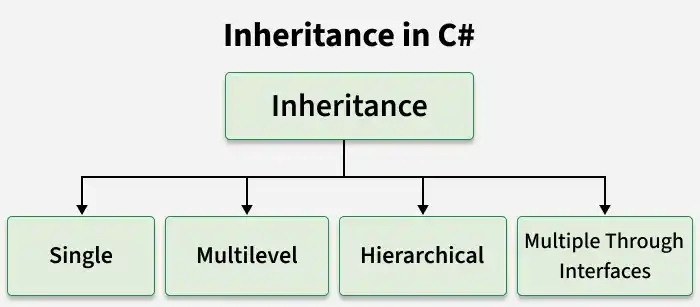
The following four types are commonly discussed in C# inheritance.
1. Single Inheritance
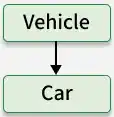
Single inheritance occurs when a derived class inherits from one base class. It allows the derived class to reuse the functionality of its parent class.
using System;

// Base class
class Vehicle
{
    public Vehicle()
    {
        Console.WriteLine("This is a Vehicle");
    }
}

// Derived class
class Car : Vehicle
{
    public Car()
    {
        Console.WriteLine("This Vehicle is Car");
    }
}

class Geeks
{
    static void Main()
    {
        Car obj = new Car();
    }
}
Output
This is a Vehicle
This Vehicle is Car
Explanation: Car inherits from Vehicle. When a Car object is created, the Vehicle constructor executes first, followed by the Car constructor.
2. Multilevel Inheritance
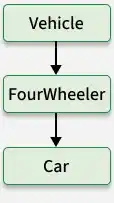
Multilevel inheritance occurs when a derived class inherits from another derived class, creating a chain of inheritance.
Example:
using System;

class Vehicle{
    public Vehicle(){
        Console.WriteLine("This is a Vehicle");
    }
}

class FourWheeler : Vehicle{
    public FourWheeler(){
        Console.WriteLine("4 Wheeler Vehicles");
    }
}

class Car : FourWheeler{
    public Car(){
        Console.WriteLine("This 4 Wheeler Vehicle is a Car");
    }
}

class Geeks{
    static void Main(){
        Car obj = new Car();
    }
}
Output
This is a Vehicle
4 Wheeler Vehicles
This 4 Wheeler Vehicle is a Car
Explanation: Car inherits from FourWheeler, which inherits from Vehicle. Creating a Car object invokes constructors in the order Vehicle -> FourWheeler -> Car.
3. Hierarchical Inheritance
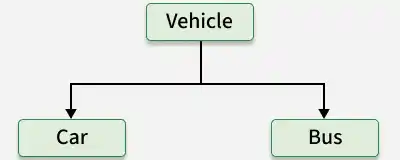
Hierarchical inheritance occurs when multiple derived classes inherit from the same base class. Each derived class can extend the base-class functionality independently.
using System;

class Vehicle{
    public Vehicle(){
        Console.WriteLine("This is a Vehicle");
    }
}

class Car : Vehicle{
    public Car(){
        Console.WriteLine("This Vehicle is Car");
    }
}

class Bus : Vehicle{
    public Bus(){
        Console.WriteLine("This Vehicle is Bus");
    }
}

class Geeks{
    static void Main(){
        Car obj1 = new Car();
        Bus obj2 = new Bus();
    }
}
Output
This is a Vehicle
This Vehicle is Car
This is a Vehicle
This Vehicle is Bus
Explanation: Both Car and Bus inherit from Vehicle. Each derived class invokes the Vehicle constructor before executing its own constructor.
4. Multiple Inheritance Through Interfaces
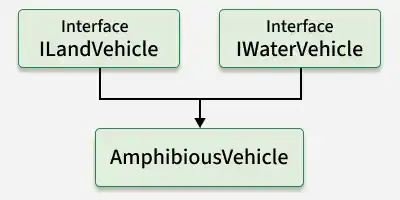
C# does not allow a class to inherit from more than one base class. However, a class can implement multiple interfaces, allowing it to provide functionality defined by different interfaces.
using System;

interface ILandVehicle{
    void LandInfo();
}

interface IWaterVehicle{
    void WaterInfo();
}

// Implements both interfaces
class AmphibiousVehicle : ILandVehicle, IWaterVehicle{
    public AmphibiousVehicle(){
        Console.WriteLine("This is an AmphibiousVehicle");
    }

    public void LandInfo(){
        Console.WriteLine("This is a LandVehicle");
    }

    public void WaterInfo(){
        Console.WriteLine("This is a WaterVehicle");
    }
}

class Geeks{
    static void Main(){
        AmphibiousVehicle obj = new AmphibiousVehicle();

        obj.WaterInfo();
        obj.LandInfo();
    }
}
Explanation: AmphibiousVehicle implements both ILandVehicle and IWaterVehicle. It provides implementations for the methods declared in each interface.
Note: Implementing multiple interfaces is not the same as inheriting from multiple classes. A C# class can inherit from only one direct base class but can implement multiple interfaces.
IS-A Relationship
The IS-A relationship represents inheritance, where a derived class is a specialized type of its base class.
For example, a Dog IS-A Animal, and a Cat IS-A Animal.
using System;

class Animal{
}

class Dog : Animal{
}

class Cat : Animal{
}

class Puppy : Dog{
}

class Geeks{
    static void Main(){
        Animal a = new Animal();
        Dog d = new Dog();
        Cat c = new Cat();
        Puppy p = new Puppy();

        Console.WriteLine(a is Animal);
        Console.WriteLine(d is Animal);
        Console.WriteLine(c is Animal);
        Console.WriteLine(p is Dog);
    }
}
Output
True
True
True
True
Explanation:
- Dog and Cat inherit directly from Animal.
- Puppy inherits from Dog and indirectly from Animal.
- The is operator checks whether an object is compatible with a specified type.
What Can Be Done in a Derived Class?
A derived class can reuse, extend, or customize the functionality provided by its base class.
- Access Inherited Members: Use accessible fields, properties, and methods defined in the base class.
- Add New Members: Declare additional fields, properties, and methods specific to the derived class.
- Override Methods: Provide new implementations of inherited virtual or abstract methods using override.
- Hide Members: Use the new keyword to explicitly hide inherited members.
- Access Base-Class Members: Use the base keyword to call accessible base-class methods or properties.
- Invoke Base-Class Constructors: Use base() in a constructor initializer to invoke a particular base-class constructor.
Note: Constructors are not inherited. Also, private members of a base class cannot be accessed directly from a derived class, although they remain part of the object's base-class state.
Advantages of Inheritance
- Code Reusability: Allows derived classes to reuse existing functionality, reducing code duplication.
- Extensibility: Makes it possible to add specialized functionality without changing the base class.
- Runtime Polymorphism: Allows derived classes to override virtual or abstract members and provide different implementations.
- Class Hierarchy: Organizes related classes into meaningful relationships, making code easier to understand and manage.
Limitations of Inheritance
- Tight Coupling: Changes to a base class can affect its derived classes.
- Increased Complexity: Deep inheritance hierarchies can make code harder to understand, debug, and maintain.
- No Multiple Class Inheritance: A C# class cannot directly inherit from more than one base class.
- Reduced Flexibility: Inheritance creates a fixed type relationship, which may be unsuitable when behavior needs to change independently.
