

The .NET Framework is a software development framework developed by Microsoft for building and running applications, primarily on the Windows operating system. It provides a runtime environment, reusable libraries, and development tools that simplify application development.
- Supports multiple programming languages such as C#, VB.NET, and F#.
- Provides the Common Language Runtime (CLR) for executing applications.
- Provides a large collection of reusable libraries through the Framework Class Library (FCL).
Main Components of .NET Framework
The .NET Framework mainly consists of the following components:
1. Common Language Runtime (CLR)
The Common Language Runtime(CLR) is the execution environment of the .NET Framework. It manages the execution of .NET applications and provides several services during program execution.
The CLR is responsible for:
- Memory management
- Garbage collection
- Exception handling
- Thread management
- Security
- Type safety
- Code execution
How Does CLR Execute a .NET Program?
When a program is written in a .NET language such as C#, it goes through several stages before execution:
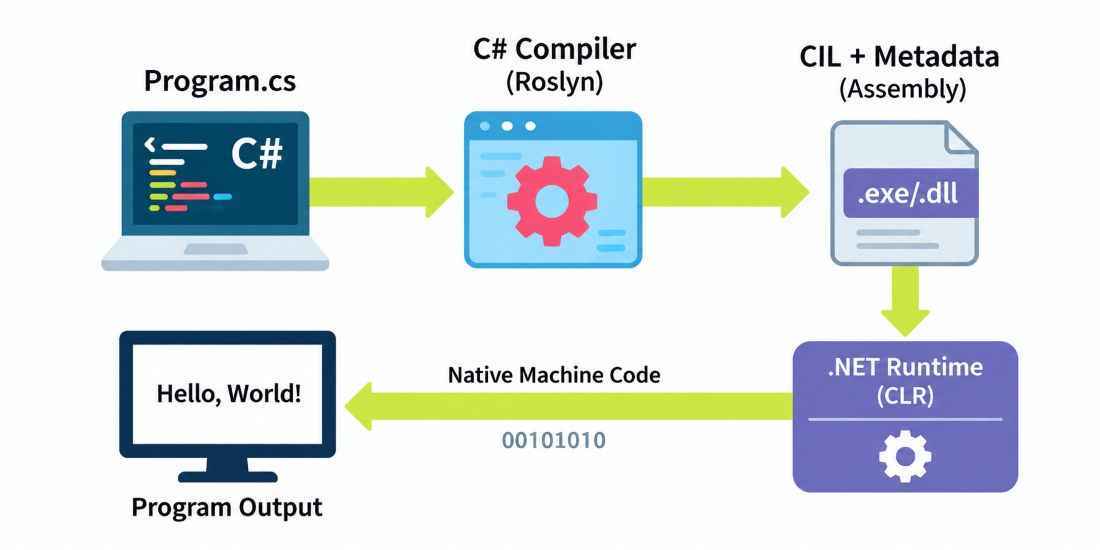
The compiler converts the source code into Intermediate Language (IL). When the application runs, the JIT (Just-In-Time) compiler converts the IL into native machine code that can be executed by the operating system.
2. Framework Class Library (FCL)
The Framework Class Library (FCL) is a collection of reusable classes, interfaces, and APIs provided by the .NET Framework. It provides ready-to-use functionality for common programming tasks, such as:
It provides ready-to-use functionality for common programming tasks, such as:
- File handling
- Input and output operations
- String manipulation
- Collections
- Database access
- Networking
- XML processing
- Threading
- Security
For example, developers can use classes such as String, List<T>, File, and DateTime instead of implementing these functionalities from scratch.
.NET Programming Languages
The .NET ecosystem supports various programming languages developed by Microsoft and third-party contributors. Some of the most widely used languages are:
- C#: It is Microsoft's primary programming language for modern .NET development. It is an object-oriented language used to build web, desktop, cloud, and other applications.
- VB.NET: VB.NET (Visual Basic .NET) is a programming language designed for developing applications using the .NET platform. It has a syntax based on the Visual Basic family of languages.
- F# .NET: F# is a functional-first programming language that runs on the .NET platform. It is commonly used for data processing, mathematical programming, and applications that benefit from functional programming.
- C++ .NET: An extension of C++ designed for managed code applications.
- Other Languages: JScript.NET, C Omega, ASML, and more.
Evolution of .NET Technology
.NET is a software development platform introduced by Microsoft in 2002. It provides a runtime environment and reusable libraries for developing Windows desktop applications, web applications, and web services. It supports multiple programming languages
- OLE: OLE (Object Linking and Embedding) was a Microsoft technology that allowed objects or data created in one application to be linked to or embedded in another application.
- COM: COM (Component Object Model) is a Microsoft technology that enables software components to communicate with each other.
- .NET: Microsoft introduced .NET as a more modern development platform that provided a managed runtime, common libraries, language interoperability, and improved development capabilities.
Is .NET Platform Dependent or Platform Independent?
By default, .NET applications were designed to be platform-dependent, primarily running on Windows. But because of Mono (a cross-platform framework), and .NET Core, developers can now run .NET applications on Linux, macOS, and even mobile platforms.
Mono Framework
Mono is an open-source implementation of the .NET platform that was created to bring .NET applications to operating systems beyond Windows.
- It supported platforms such as Linux and macOS and played an important role in the history of cross-platform .NET development.
- Today, modern .NET provides Microsoft's primary cross-platform implementation, while Mono remains relevant in specific technologies and projects.
.NET Version Compatibility Table
Release History of .NET Framework and its compatibility with the different Windows version are below:
| .NET Version | CLR Version | Development tool | Windows Support |
|---|---|---|---|
| 1.0 | 1.0 | Visual Studio .NET | XP SP1 |
| 1.1 | 1.1 | Visual Studio .NET 2003 | XP SP2, SP3 |
| 2.0 | 2.0 | Visual Studio 2005 | N/A |
| 3.0 | 2.0 | Expression Blend | Vista |
| 3.5 | 2.0 | Visual Studio 2008 | 7, 8, 8.1, 10 |
| 4.0 | 4 | Visual Studio 2010 | N/A |
| 4.5 | 4 | Visual Studio 2012 | N/A |
| 4.5.1 | 4 | Visual Studio 2013 | N/A |
| 4.5.2 | 4 | N/A | N/A |
| 4.6 | 4 | Visual Studio 2015 | N/A |
| 4.6.1 | 4 | Visual Studio 2015 Update 1 | N/A |
| 4.6.2 | 4 | N/A | 10 v1607 |
| 4.7 | 4 | Visual Studio 2017 | 10 v1703 |
| 4.7.1 | 4 | Visual Studio 2017 | 10 v1709 |
| 4.7.2 | 4 | Visual Studio 2017 | 10v 1803 |
| 4.8 | 4 | Visual Studio 2019 | 11 |
| 4.8.1 | 4 | Visual Studio 2019 | 10v 20H2 |
| 6 | - | Visual Studio 2022 | 11 |
8.0 (2024) | - | Visual Studio 2024 | 10 |
9.0 (2025) | - | Visual Studio 2025 | 11 |
Advantages
- Supports languages like C#, F#, and VB with shared libraries.
- Runs on multiple OS using .NET Core and Mono.
- Large ecosystem with tools, libraries, and support.
- Built-in features to protect applications from threats.
- Pre-built tools and libraries speed up development.
Limitations
- The .NET Framework is primarily designed for Windows, which limits its use in cross-platform applications.
- It may require significant system resources and storage for certain applications.
- Some development tools and third-party components may require paid licenses.
- It is not the best choice for low-level programming or applications requiring direct hardware control.
- Beginners may need time to understand object-oriented programming concepts and the overall .NET ecosystem.
